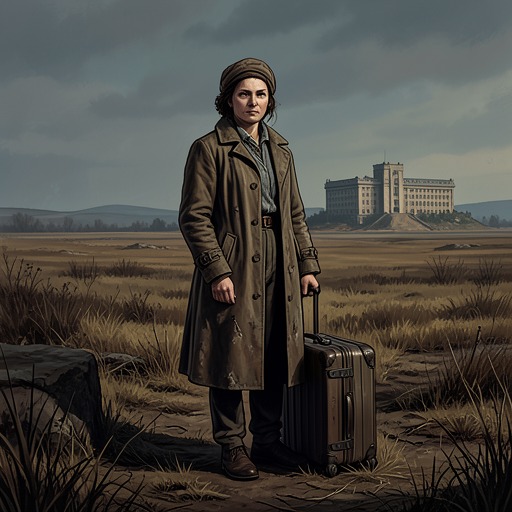
Shirley Sets a Fire to Call for Help
The Hanging GirlShirley’s fire is a desperate attempt to make her confinement visible: when shouting and a hole in the skylight fail to bring help, she uses her glasses to focus sunlight on paper torn from Pirjo’s blue notebook. The fire changes the scene from silent isolation to an emergency response, and Shirley is carried out alive, soot-blackened and barely in time.
The first plan: sunlight and a skylight
Shirley’s means are improvised from what she has at hand. She retrieves her reading glasses from her toiletry bag, an ugly pair bought at a Tiger discount store in the Southside Shopping Centre in Wandsworth in the hope that they would help her apply her makeup more flatteringly. Now their possible use is far more consequential. Judging the sun’s position, she calculates whether she can complete her venture in a day or will need another day to continue it. She kneels and tries to concentrate the rays through the glass into a burning point on the wall.
The attempt does not work quickly. Shirley has learned in first-aid courses, taken when she once considered volunteering as a paramedic, that people who die in fires are generally unconscious from smoke inhalation and feel no pain. The knowledge does not make fire safe; it gives her a grim understanding of one possible end. Her plan is to start a fire with the glasses, then run into the bathroom and hope someone raises the alarm and reaches the house before the flames take her. If no one comes, she accepts that events may simply run their course. The bathroom is small, she reasons, and its oxygen would be used up quickly.
Before the attempt, Shirley tears up Pirjo’s blue notebook, which contains Atu’s pearls of wisdom, and piles the crumpled pages against the wall as kindling. The choice gives the notebook a practical fate opposed to the authority its contents represent: its pages, once carriers of teaching, become fuel in Shirley’s attempt to escape an otherwise unresponsive situation.
Failure, then ignition
After sitting for five minutes, Shirley concludes that the focused light is not becoming warm enough to burn. She looks to the skylight and sees a shrinking opportunity: in just under an hour, the sun will have passed far enough overhead that direct light will no longer enter the room. She also doubts that waiting until another day would solve the problem. The windows may refract the sunlight so extensively that it loses the heat the plan requires. The delay is not simply suspense; it is a practical contest with the changing angle of the sun and the limits of the glass.
Shirley tries to attract attention by screaming as loudly as she can, now that there is a hole in the skylight. She keeps at it for ten minutes. The house is so well insulated that nobody hears her. The failed call makes the barrier concrete: even a breach overhead and sustained shouting cannot connect her to anyone outside. Yet Shirley does not describe herself as overcome by sadness or fear. She laughs briefly at the absurdity of the situation and experiences hunger and thirst as producing an unexpected feeling of euphoria, lightness, freedom, and strength. That bodily state sits uneasily beside the danger of her circumstances; it is not evidence that the danger has passed.
She returns to the glasses. Kneeling again, she gathers the sun’s rays first into a small bright point on the wall and then onto one crumpled page from the notebook. The paper slowly darkens. Unlike the earlier attempt, this is a visible change in the kindling: the light is no longer only a calculation or a failed possibility. The page’s gradual darkening marks the turn on which Shirley’s plan depends, as she tries to convert a narrow interval of direct sunlight into a signal powerful enough to bring help.
Rescue and aftermath
When responders arrive from the area of the fire, people nearby whisper and cover their faces as the events unfold. Some call out, “Shirley!” The name identifies the woman being carried as alive: she reaches out toward people along the way and touches their hands, though only a few stroke her fingers in return. A commander assigns one ambulance to Shirley and another to the dead woman; the Danish officers are to travel in an emergency car. Shirley’s attempt has summoned a response, but it has not produced an uncomplicated rescue scene.
The rescuers place Shirley’s stretcher alongside the other stretcher and remove her oxygen mask so they can speak to her. She coughs, but appears able to answer questions. A rescue worker rinses soot from the area around her eyes. Her hair and skin are blackened, and the account stresses how close she has come to dying: it is astonishing that she survived, and the rescuers appear to have reached her at the last moment. She looks extremely sad and may still be in shock; she had perhaps not reckoned with getting out alive. Then she turns toward the other stretcher and blinks until she understands what she sees. The passage leaves the dead woman unnamed in this scene, making Shirley’s survival inseparable from the presence of another death without explaining their relationship here.
Significance of the attempt
The fire is both an act of resistance and a hazardous means of communication. Shirley first tries the ordinary human signal of a scream; the insulated house absorbs it. She then recruits objects and conditions—the discount-store glasses, the skylight, the sun’s limited passage, and the pages of Pirjo’s notebook—to make a signal that cannot be ignored. None works instantly, and the first failure threatens to leave her with no time. The eventual rescue reverses that isolation, but the stretchers placed side by side preserve the cost and ambiguity of what has happened. Shirley is alive, yet the scene offers no triumphal release: her body is covered in soot, she is coughing and possibly shocked, and her attention turns toward the dead woman beside her.